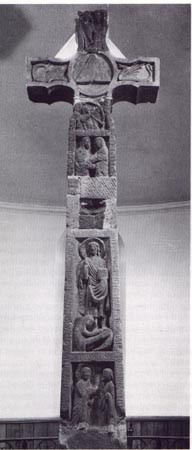
Here's something sweet I learned about this week in British Survey I. On the western border of England and Scotland, there is an ancient stone monument called the Ruthwell Cross. It is considered one of the most valuable monuments in the development of the English language because inscribed on it are 3 languages, the evolution of Old English transfixed in stone. There are pictographs (depicting scenes from the life of Christ, animals feeding, vines, etc.), as well as runes and Latin. When translated, the runes echo lines from a poem called "The Dream of the Rood," which I had to read this week for British Survey. Wikipedia has the Old English with the translation of the runes from the poem into the Old English they represent, as well as the modern English:
"Krist wæs on rodi. Hweþræ' þer fusæ fearran kwomu æþþilæ til anum."
"Christ was on the cross. Yet the brave came there from afar to their lord."
In the poem from which the above lines come, the unnamed author dreams that he sees the cross of Christ, all covered in gold and jewels, which then begins to bleed, altnerating back and forth between bright yellow gold and bright red blood. Then the cross speaks - literally speaks - about its role in the crucifixion. I thought these lines were particularly powerful:
"Then I saw the lord of mankind
hasten eagerly when he wanted to ascend onto me.
Then I dared not bow down or break,
against the lord's word, when I saw
the ends of the earth tremble."
The Anglo-Saxons had a culture that revolved around stories of great battles and heroes that fought in them. But like any people who hear the Gospel, they needed a way for the Truth to make sense within their present culture. Whoever wrote this poem knew that Christ made the most sense to the Anglo-Saxons if he was depicted as a glorious hero, a warrior who eagerly embraced the chance to die for those He loved and save them from their sins. That makes this poem extremely significant and precious, as more than just a poem that marks the development of English. It's a testimony to the Truth - from over 1000 years ago.

very very interesting!! hey i've been reading Life By His Death here... i can't remember the author but it's really good so far!
ReplyDeletei miss you tons...
the teachers all teach in English and transitions are basically 'party time' for the students because the students all stay in one class and different teachers come to them. basically all the teachers co-teach.
lots of love to you:)